
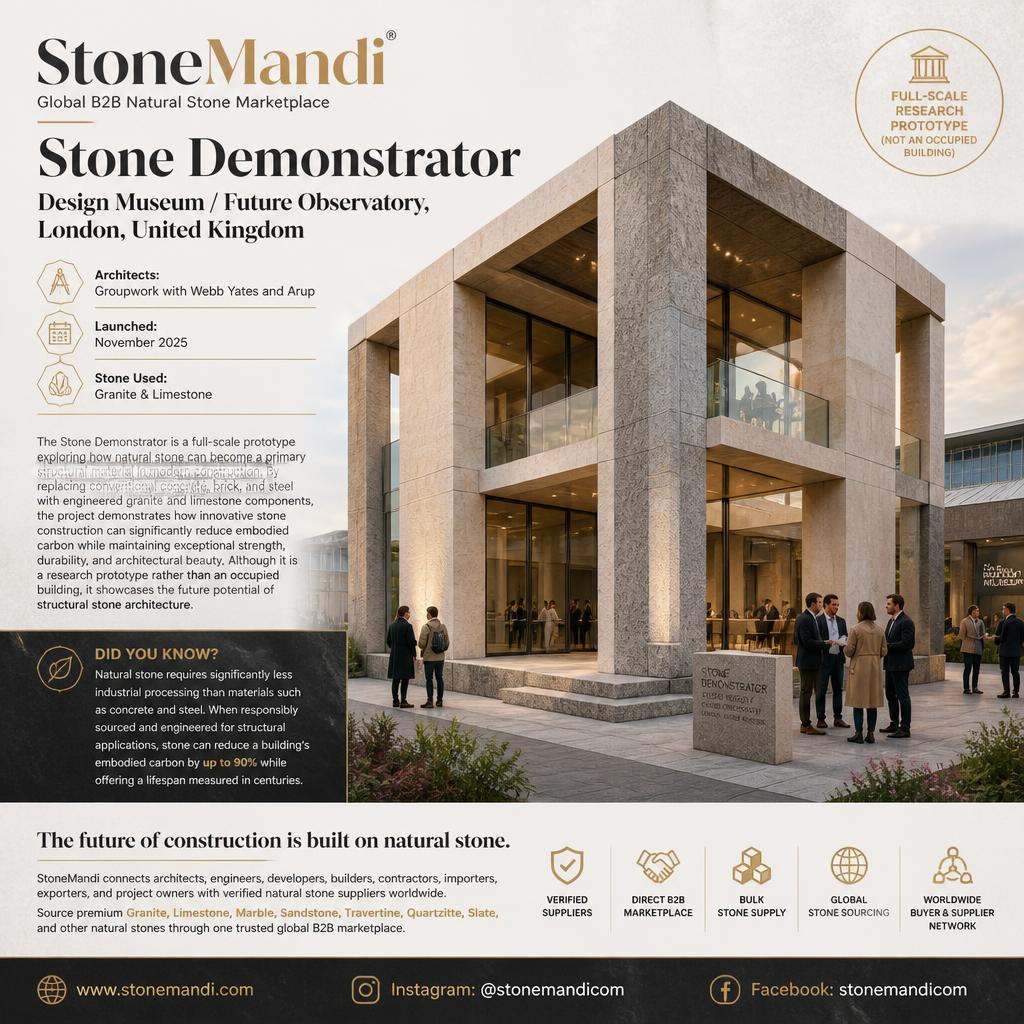
At Empress Place on the Earls Court development site in West London, a striking three-storey structure of pale granite and limestone has become one of the most talked-about additions to the city’s architectural landscape. Known as the Stone Demonstrator, this full-scale research prototype is a bold statement: natural stone, not steel or concrete, may hold the key to the future of low-carbon construction.
About the Project
The Stone Demonstrator was commissioned by Future Observatory, the Design Museum’s national research programme for the Green Transition, in partnership with the Earls Court Development Company and funded by the UKRI Arts and Humanities Research Council. <cite index=”7-1″>It opened in October 2025, standing 6.5 metres tall as a boundary-pushing three-storey prototype.</cite>
Rather than being an occupied building, the Stone Demonstrator is a live, open-air experiment — a full-scale test of how pre-tensioned stone can be engineered as a primary structural material in place of conventional concrete, brick, and steel.
<cite index=”8-1″>The structure is assembled from stone blocks threaded with steel tendons and compressed to form pre-tensioned beams and columns, with floorplates that combine pre-tensioned stone slabs, dowel-laminated timber, and a hybrid stone-and-glulam composite panel developed by the project’s engineers.</cite> <cite index=”8-1″>Its self-supporting stone brick façade is designed to produce around 90 percent lower emissions than standard fired clay brick.</cite>
Credit Where It’s Due: The Team Behind the Design
The Stone Demonstrator is the work of architecture practice Groupwork, led by founder and chairman Amin Taha, working alongside structural engineers Webb Yates and Arup. <cite index=”5-1″>The project builds on nearly two decades of the team’s experimentation with structural stone, following their earlier and widely discussed 15 Clerkenwell Close building, which was shortlisted for the RIBA Stirling Prize.</cite>
Speaking about the intent behind the Stone Demonstrator, Amin Taha described it as a way <cite index=”1-1″>to demonstrate a viable alternative to everyday building methods at a fraction of the embodied carbon, bringing together almost two decades of prototyping and testing.</cite> Steve Webb of Webb Yates has been equally vocal about the urgency of the shift, arguing that <cite index=”1-1″>industries built around fossil-fuel-era materials like steel and concrete have a vested interest in resisting change.</cite>
The project also draws on an extensive network of specialist collaborators — from stonemasons and quarries to timber engineers and installers — reflecting just how many skilled hands go into a genuinely low-carbon stone structure.
Why Granite and Limestone? The Case for Natural Stone
The Stone Demonstrator uses granite and limestone — two of the most trusted natural stones in construction history — and for good reason:
Granite is an igneous rock formed under intense heat and pressure, giving it exceptional compressive strength, hardness, and resistance to weathering. It is dense, low in porosity, and highly resistant to abrasion, making it ideal for structural columns, load-bearing elements, and high-traffic surfaces that need to perform for centuries with minimal maintenance.
Limestone is prized for its workability, thermal mass, and timeless aesthetic. It has been used in landmark structures for thousands of years, and modern engineering techniques — such as the pre-tensioning method used in the Stone Demonstrator — now allow limestone to carry structural loads once reserved for steel and concrete.
Both stones share a critical advantage over conventional building materials: they require far less industrial processing. Quarried and cut rather than manufactured through energy-intensive chemical processes, natural stone can reduce a building’s embodied carbon by up to 90 percent compared to concrete and steel, all while offering a lifespan measured in centuries rather than decades.
A Signal for the Construction Industry
The significance of the Stone Demonstrator extends beyond its physical footprint. <cite index=”9-1″>It reduces embodied carbon by roughly 70 percent compared to a reinforced concrete frame, and by around 90 percent compared to a steel frame.</cite> At a time when the built environment is responsible for a significant share of global carbon emissions, this project is a working proof-of-concept that natural stone can meet modern structural codes while dramatically cutting environmental impact.
For architects, engineers, and developers watching the transition toward greener construction, the Stone Demonstrator offers a compelling message: the future of building may look a lot like its ancient past.
Sourcing Natural Stone for Your Own Projects
Projects like the Stone Demonstrator highlight the growing global demand for high-quality granite, limestone, and other natural stone products in structural and architectural applications. Whether you’re an architect exploring stone construction, a contractor sourcing bulk material, or a supplier looking to reach new markets, StoneMandi.com connects you with verified natural stone suppliers worldwide.
As a global B2B natural stone marketplace, StoneMandi.com makes it easy to source granite, limestone, marble, sandstone, travertine, quartzite, and slate directly from trusted quarries and exporters — bringing the same materials powering projects like the Stone Demonstrator within reach of architects and builders everywhere.
To explore verified suppliers and start sourcing natural stone for your next project, visit StoneMandi.com today.
Sources: Design Museum, Webb Yates Engineers, Groupwork/Amin Taha, Earls Court Development Company (ECDC), and Delancey press materials on the Stone Demonstrator project (2025).