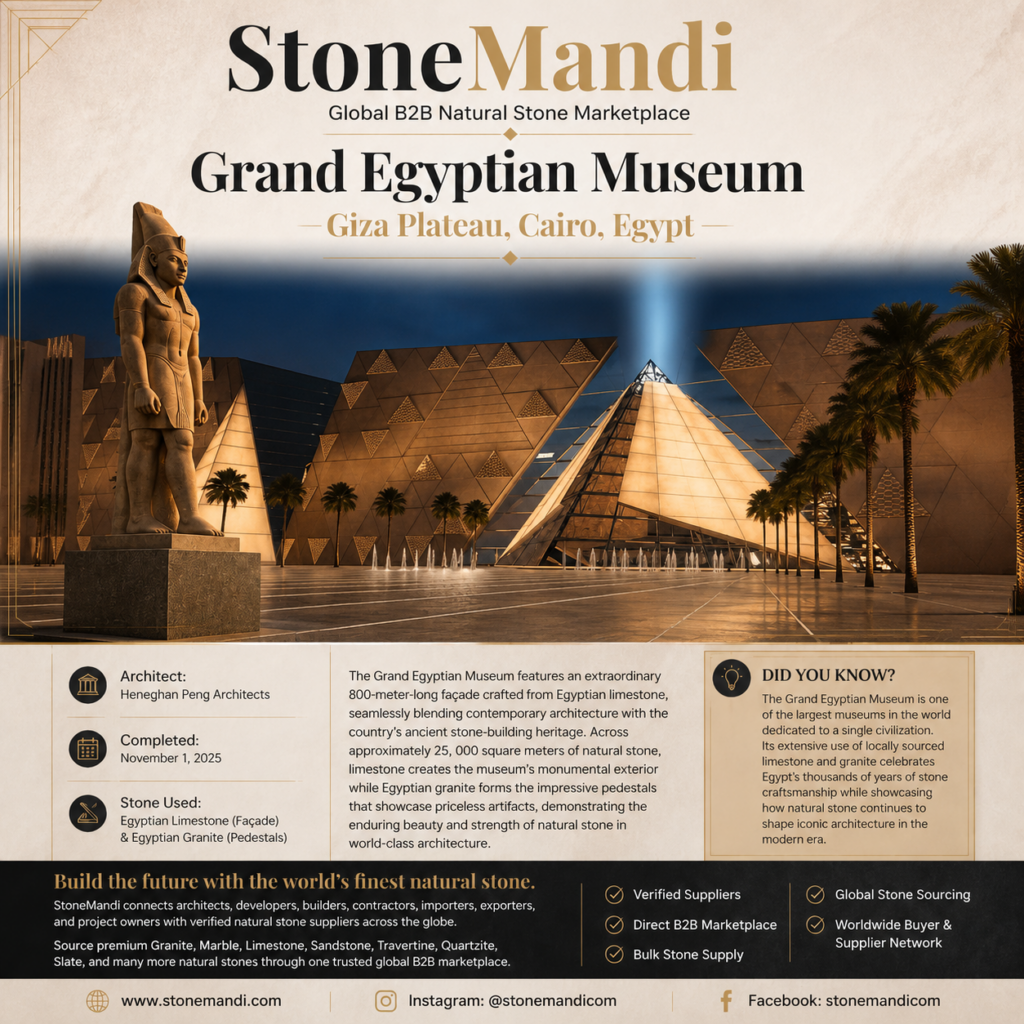
Location: Giza Plateau, Cairo
Egypt Architect: Heneghan Peng Architects (Dublin, Ireland)
Completed: November 1, 2025
Stone Used: Egyptian Limestone (façade) and Egyptian Granite (pedestals)
An Architectural Landmark Rising Beside the Pyramids
Just over a mile from the Great Pyramids of Giza stands one of the most ambitious cultural buildings of the 21st century — the Grand Egyptian Museum (GEM). Conceived as the largest museum in the world dedicated to a single civilization, the GEM houses more than 100,000 pharaonic antiquities, including the complete Tutankhamun collection and the ancient Solar Boat relocated from the pyramids themselves.
The project was designed by Heneghan Peng Architects, the internationally acclaimed Dublin-based firm that won the international design competition for the museum back in 2003. Full credit for the museum’s vision belongs to this team, whose design deliberately aligns the building’s angular geometry with the three pyramids of Giza, creating visual axes that connect visitors to the ancient landscape even before they step inside. Construction began in 2005 and, despite delays caused by regional economic and political disruptions over the following two decades, the museum reached full completion on November 1, 2025 — a testament to the enduring vision of its architects and the craftsmen who executed it.
The Symbolism Behind the Facade
Beyond its engineering, the GEM’s facade was conceived as a piece of storytelling in stone. As reported by Egypt Today, the facade’s design was built around the idea of expressing Egyptian civilization through its own raw materials rather than imported ones, with the museum’s eastern wall organized around a repeating pyramid motif that nods to Egypt’s ancient architectural language while framing views toward the Giza plateau itself. According to the same report, an earlier version of the design had called for a freestanding metal-and-imported-marble wall set apart from the museum body, a concept that was ultimately dropped in favor of a facade more faithful to Egypt’s own building traditions and materials. That shift toward locally rooted materials is part of what makes the finished structure feel less like an import and more like an extension of the plateau it sits on.
An 800-Meter Façade Built from Natural Stone
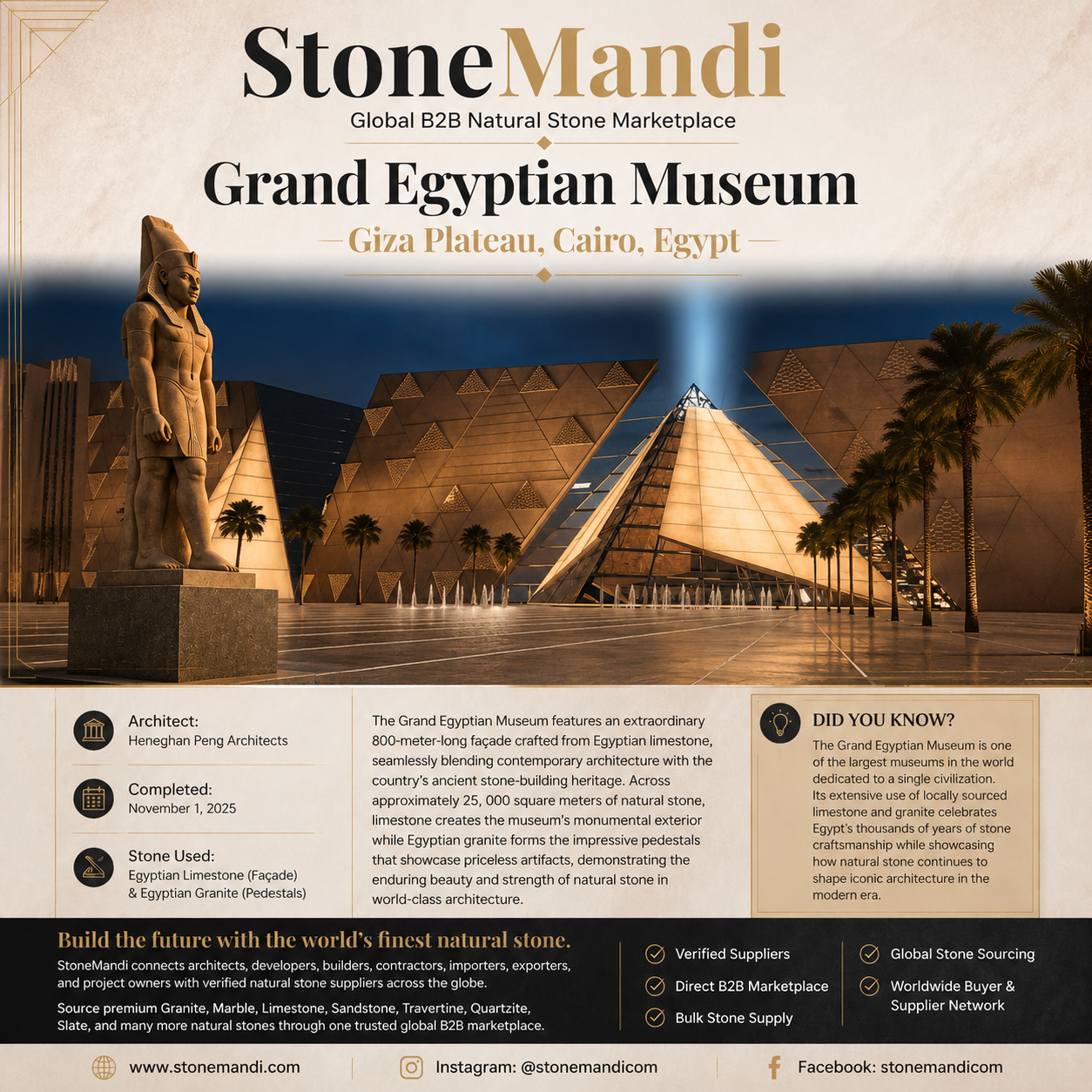
What makes the Grand Egyptian Museum extraordinary from a construction standpoint is its monumental facade: an 800-meter-long wall built almost entirely from natural stone, using approximately 25,000 square meters of Egyptian limestone. The triangular stone panels, produced using advanced thin-slab cladding techniques, blend seamlessly with glass sections to create a surface that shifts in tone and texture throughout the day, echoing the desert hues of the Giza plateau.
Complementing the limestone facade is Egyptian granite, used for the museum’s massive pedestals that support ancient statues and artifacts across the site. Together, these two stones tie the building physically and symbolically to Egypt’s millennia-old tradition of stone construction — the same tradition that produced the pyramids visible just beyond the museum’s windows.
Why Egyptian Limestone and Granite Are Ideal for Construction
The choice of limestone and granite wasn’t just aesthetic — it was practical:
Egyptian Limestone is prized for its workability, light color palette, and natural thermal performance. It reflects heat effectively, helping regulate interior temperatures in hot climates, and can be cut and finished into thin, precise slabs for large-scale cladding without losing structural integrity.
Egyptian Granite is one of the most durable natural stones available, known for its resistance to weathering, abrasion, and heavy load-bearing use. This makes it ideal for pedestals, flooring, and structural elements that must endure both time and heavy foot traffic for generations.
Both stones are locally sourced, reducing transportation impact while reinforcing a sense of place — a building that literally rises from the same land as the artifacts it protects.
This combination of durability, thermal efficiency, and natural beauty is exactly why limestone and granite remain top choices for architects and developers working on large-scale, long-lasting construction and cladding projects worldwide.
Sourcing Natural Stone for Projects Like This
Projects of this scale depend on reliable access to high-quality, verified natural stone — and that’s where StoneMandi.com comes in. As a global B2B natural stone marketplace, StoneMandi.com connects architects, developers, contractors, and project owners with verified suppliers of granite, marble, limestone, sandstone, travertine, quartzite, slate, and many more natural stones.
Whether you’re sourcing Egyptian limestone for a facade or granite for structural pedestals, StoneMandi.com offers a direct B2B marketplace built for bulk stone supply, global sourcing, and a trusted worldwide buyer-and-supplier network — making it easier to bring ambitious architectural visions, like the Grand Egyptian Museum, to life.
Quick Facts
Architect: Heneghan Peng Architects Location: Giza Plateau, Cairo, Egypt Completed: November 1, 2025 Facade Length: ~800 meters Facade Stone: Egyptian Limestone Pedestal Stone: Egyptian Granite Stone Area (Facade): ~25,000 sq. meters Significance: Largest museum in the world dedicated to a single civilization
Source your next project’s natural stone through StoneMandi.com — the global B2B marketplace built for verified suppliers, bulk supply, and worldwide sourcing.
Sources / Image Credit: Egypt Today, “The story behind the pyramid wall design of Grand Egyptian Museum,” https://www.egypttoday.com/Article/4/91119/The-story-behind-the-pyramid-wall-design-of-Grand-Egyptian