Oxford’s skyline has welcomed a striking new addition. The Stephen A. Schwarzman Centre for the Humanities, the University of Oxford’s largest single-building project, officially opened its doors to students on 13 October 2025. Clad in warm, honey-toned limestone, the building is a masterclass in how natural stone can bridge centuries of architectural tradition with contemporary academic design — a project proudly featured by StoneMandi.com, the global B2B natural stone marketplace, for its exceptional use of natural stone in modern institutional architecture.
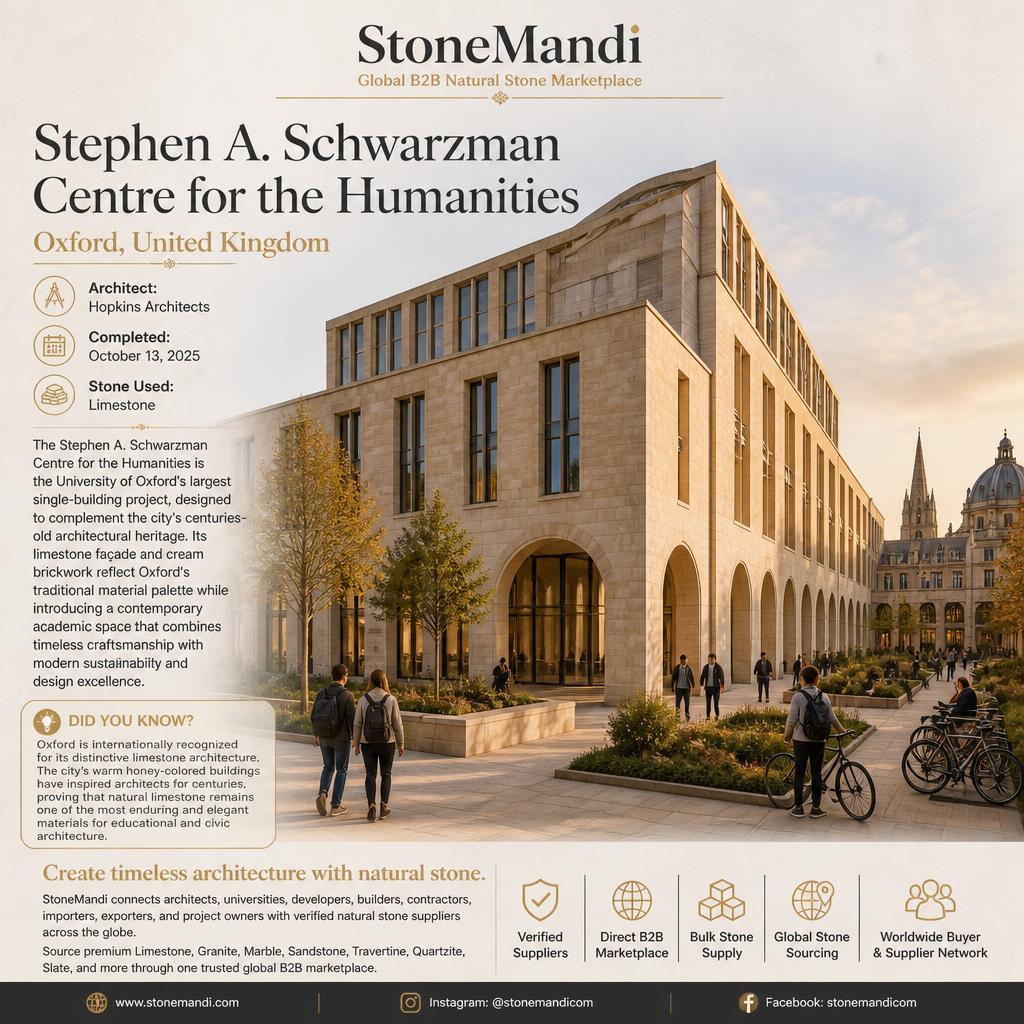
Project Overview
Funding: Largely funded by a £185 million donation from Stephen A. Schwarzman — the largest single gift in the University of Oxford’s history
Location: Radcliffe Observatory Quarter, Oxford, United Kingdom
Architect: Hopkins Architects
Groundbreaking: February 2023
Completed / Opened to students: 13 October 2025
Size: 25,300 square metres
Stone used: Clipsham limestone (with handmade buff brick from York)
Situated within the ten-acre Radcliffe Observatory Quarter, the Centre now unites nine humanities faculties and seven libraries and collections under a single roof for the first time in the university’s history, alongside a concert hall, cinema, exhibition spaces, and public café and restaurant areas open to the wider community.
Credit to Hopkins Architects
The design credit for this landmark belongs to Hopkins Architects, the British architecture practice that won the commission through a competitive process. Hopkins Architects faced the considerable challenge of designing a building on a scale never before undertaken by Oxford University, while ensuring it sat comfortably within a city renowned for its 900 years of architectural heritage.
Hopkins partner Andrew Barnett described the ambition clearly: the goal was a building that felt genuinely contemporary while still speaking to the university’s long history. The result is a composition that breaks the building’s considerable mass into a series of smaller volumes, echoing the scale and rhythm of Oxford’s historic quadrangles while introducing an open, welcoming public “street” at its heart — a notable departure from the university’s traditionally enclosed courtyard model.
The technical achievement is equally impressive: the Centre is certified as England’s largest Passivhaus scheme and houses the world’s first Passivhaus concert hall, meaning it meets some of the most rigorous energy-efficiency standards in construction while still delivering acoustically world-class performance spaces.
The Stone: Why Clipsham Limestone Was the Right Choice
The facades of the Schwarzman Centre are faced in Clipsham limestone, quarried in Rutland, England — the same limestone family long associated with Oxford’s honey-coloured historic buildings. Over 18,500 individual stones and 160,000 bricks were laid into moulds and cast off-site as part of a precast concrete facade system, a method that combined the precision of modern construction with the enduring, hand-crafted character of traditional stonework.
Clipsham limestone was selected for several reasons that make it an excellent choice for major construction and civic projects:
- Warm, consistent tone — Clipsham’s honey-gold colour closely matches the historic limestone palette found throughout Oxford, allowing a large new building to feel immediately at home in its surroundings.
- Fine grain and workability — its fine, even texture allows for crisp detailing and tight tolerances, essential for the precast panel system and precise joint lines used on this project.
- Proven durability — Clipsham limestone has a long track record of strong long-term performance on prestigious UK buildings, standing up to weathering while ageing gracefully.
- Compatibility with sustainable design — as the outer protective layer of a highly engineered building envelope, the limestone helped the Centre achieve Passivhaus certification, showing that natural stone and rigorous environmental performance are far from mutually exclusive.
These same qualities — durability, workability, and timeless aesthetic appeal — are exactly why limestone remains one of the most trusted materials in architecture and civic construction worldwide, and why sourcing verified, high-quality natural stone matters so much for projects of this scale.
Sourcing Natural Stone for Landmark Projects
Projects like the Stephen A. Schwarzman Centre for the Humanities demonstrate what’s possible when architects, quarry owners, and stone contractors collaborate closely to deliver a consistent, high-performance material at scale. For architects, developers, and contractors looking to source verified natural stone — from limestone and granite to marble, sandstone, travertine, and more — StoneMandi.com connects buyers with verified natural stone suppliers around the world.
Whether you’re planning a heritage-sensitive civic building, a university campus, or a commercial development, StoneMandi.com offers a direct B2B marketplace for bulk natural stone supply, backed by a global network of verified suppliers and buyers. Explore the possibilities for your next project at StoneMandi.com.
Sources: Hopkins Architects, Arup, Stamford Stone Company, Vetter UK, Architectural Record, Architecture Today, and the University of Oxford.