Rising 225 feet above Chicago’s Jackson Park, the Obama Presidential Center Museum Building has become one of the city’s most talked-about new landmarks. Clad almost entirely in natural granite, the eight-story tower is the centerpiece of the 19.3-acre Obama Presidential Center campus, which also includes a public library branch, a community forum, an athletic center, and grounds landscaped by Michael Van Valkenburgh Associates. Construction began in August 2021, the building topped out in June 2024, and the campus opened to the public in June 2026, with a total project cost estimated at around $850 million.
The Architects Behind the Vision
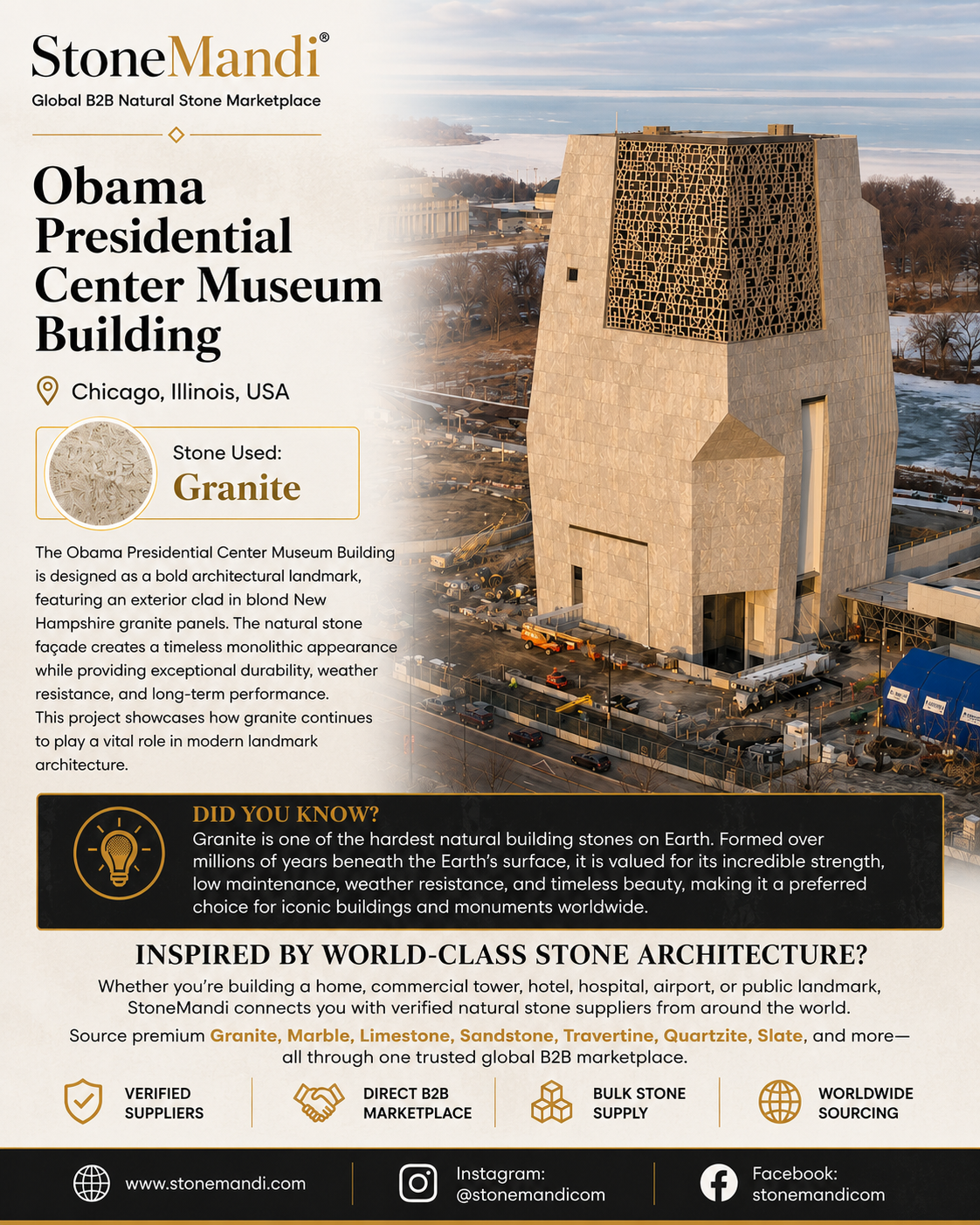
Credit for the Museum Building’s design belongs to Tod Williams Billie Tsien Architects (TWBTA), the New York studio led by architects Tod Williams and Billie Tsien, working in collaboration with Chicago-based Interactive Design Architects (IDEA) and project partner Paul Schulhof. Their concept for the tower was inspired by a simple but powerful image: four hands coming together and reaching upward. That idea gives the building its monolithic, sculptural form, one that architects say was intentionally designed to look different from every angle, so it reads as an iconic, memorable piece rather than a conventional office block or museum box.
Near the top of the tower, five-foot-tall carved letters spell out words from President Obama’s 2015 speech commemorating the 50th anniversary of the Selma-to-Montgomery marches. The cut lettering doubles as a screen for the public “Sky Room” observation deck, letting daylight spill into the space and connecting the building’s architecture directly to its historical purpose. The north facade also carries an 83-foot glass artwork by artist Julie Mehretu, titled “Uprising of the Sun.”
TWBTA describes the project as a symbol of President Obama’s journey from community organizer to president of the United States, and the design was shaped around a broader goal: creating a space that empowers visitors to understand history while inspiring them to act in their own communities. Whatever one makes of its bold, monolithic exterior, which has drawn both praise and criticism, the ambition behind the design is unmistakable, and it stands as a significant addition to Chicago’s long tradition of architecture as public statement.
Why Granite Ended Up on the Facade
The Museum Building wasn’t always meant to be granite. Early design plans called for marble, but local contractors raised a practical concern: marble doesn’t hold up well against Chicago’s brutal freeze-thaw winters and extreme seasonal temperature swings. Williams and Tsien responded by switching to New Hampshire tapestry granite, a stone chosen as much for its performance as its appearance. Its natural veining gives the tower a marble-like richness and warmth, while its density and hardness let it withstand decades of harsh Midwest weather without significant wear.
Tod Williams has spoken about how the granite gives the building an almost emotional quality, appearing dark and brooding under cloud cover, then glowing warmly whenever the sun comes out. That responsiveness to light and weather is part of what makes the material feel alive rather than static, despite the building’s imposing scale.
Why Granite Remains a Top Choice for Landmark Buildings
Granite is one of the hardest natural building stones on Earth, formed over millions of years deep within the planet’s crust. That geological origin is exactly why it performs so well in demanding architectural settings. It resists weathering and freeze-thaw cycling better than most natural stones, which matters enormously in a climate like Chicago’s. It requires very little long-term maintenance compared to softer stones like marble or limestone, holding its finish and structural integrity for decades with minimal intervention. Its natural color variation and veining mean no two installations look quite the same, giving every granite-clad project a distinctive, one-of-a-kind character. And because it is so dense and durable, granite facades are built to perform reliably for generations rather than needing repair or replacement on a shorter cycle.
These combined qualities are exactly why granite continues to show up on civic buildings, memorials, museums, and other landmark structures where architects need a material that can carry both visual weight and decades of real-world wear.
Sourcing Natural Stone for Projects Like This
Projects like the Obama Presidential Center Museum Building are a reminder that the choice of stone can define a building’s identity for generations, and that getting that choice right depends on access to reliable, verified suppliers. Whether the project is a private residence, a commercial tower, a hospital, an airport, or a public landmark, sourcing premium natural stone at scale is one of the more difficult parts of construction planning.
StoneMandi.com is a global B2B natural stone marketplace built to solve exactly that problem, connecting architects, builders, and developers with verified suppliers of granite, marble, limestone, sandstone, travertine, quartzite, slate, and more. Through StoneMandi.com, buyers can source bulk stone supply directly from trusted suppliers around the world, all through a single B2B marketplace built specifically for the construction and architecture industry.
If your next project calls for the strength, durability, and timeless character of natural granite, StoneMandi.com makes it easier to find verified suppliers and source stone at scale, wherever in the world your project is located.
Sources: Obama Foundation, Chicago Architecture Center, Dezeen, WTTW Chicago News, ArchDaily, Wikipedia.