
Location: Arnsberg, Germany Architect: Bez + Kock Architekten (Stuttgart) Stone Used: Gauinger Travertine Completion: 2019
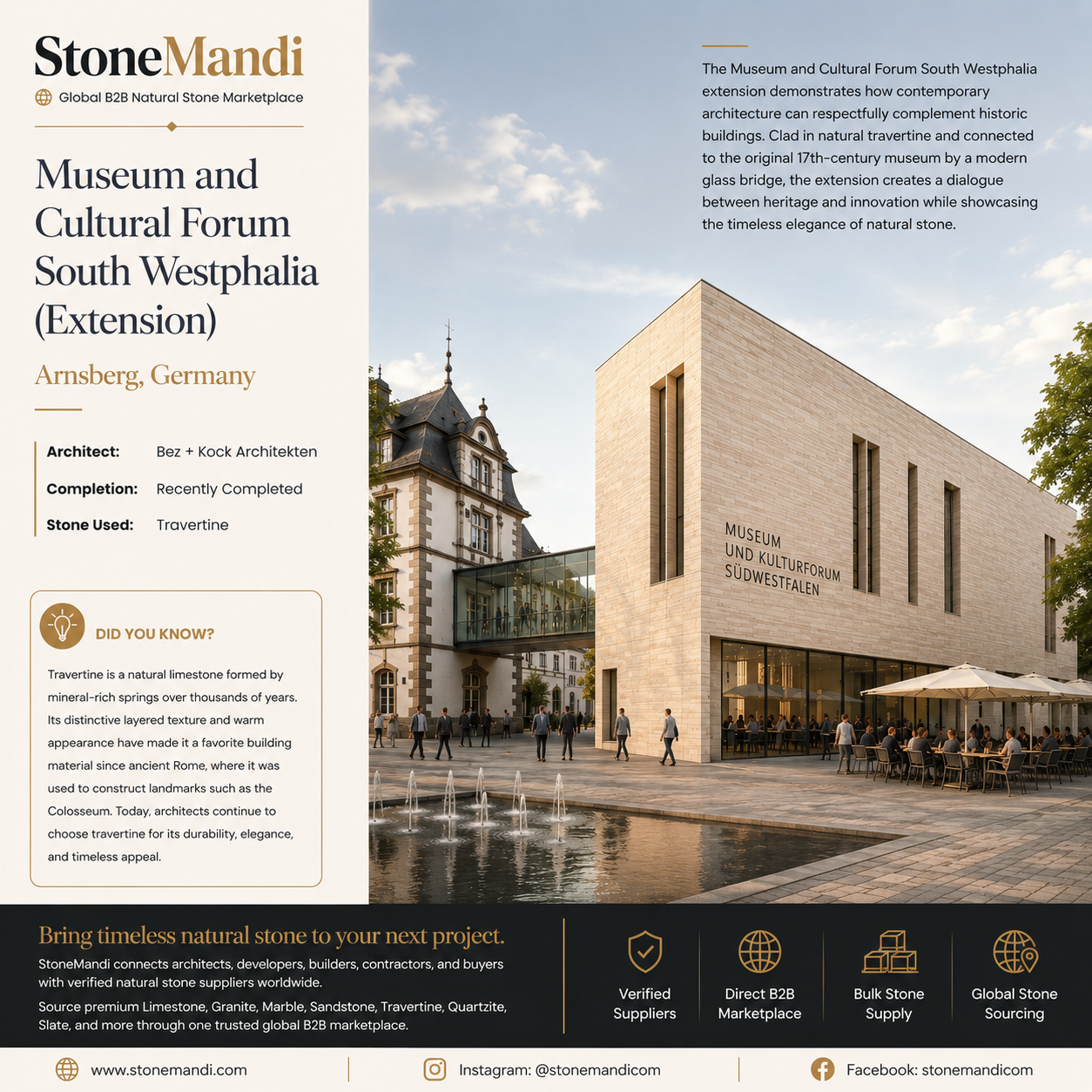
A Dialogue Between Heritage and Innovation
In the historic town of Arnsberg, Germany, a striking new chapter has been added to the story of the Sauerland Museum. Originally housed in the Landsberger Hof, a baroque palace completed in 1605, the museum has been transformed into the Museum and Cultural Forum South Westphalia through a bold, sensitively designed extension.
The project began in 2012, when Bez + Kock Architekten won an architectural competition with a proposal to connect the historic building to a new structure via an underground passage. At the client’s request, the design was later completely reworked, resulting in an above-ground solution: a panoramic glass bridge that links the basement level of the historic palace to the upper floor of the new gallery building, offering visitors sweeping views over the city.
The new extension steps down a steep hillside in three staggered levels, descending from the elevated historic quarter around the Alter Markt to the lower Ruhrstraße below. This tiered form allows the building to mediate between two very different parts of the city while ensuring that the Landsberger Hof remains the dominant silhouette on Arnsberg’s historic skyline. Carefully positioned window openings are cut into the stone volume, creating a sculptural, monolithic presence while framing views between the interior galleries and the town outside.
Credit Where It’s Due: Bez + Kock Architekten
The success of this project rests on the vision of Bez + Kock Architekten, led by Martin Bez and Thorsten Kock, whose Stuttgart-based practice reimagined a technically difficult, steeply sloped site into one of Germany’s most acclaimed recent museum buildings. Their approach preserved the historical dominance of the 17th-century Landsberger Hof while giving the surrounding region a striking, contemporary cultural landmark. The project’s design and execution were formally recognized with the Auszeichnung Vorbildlicher Bauten in Nordrhein-Westfalen 2020 and the Architekturpreis NRW 2021 in Gold, awarded by the Chamber of Architects of North Rhine-Westphalia. The design and project team also included Tilman Rösch, Lisa Diez, Meredith Atkinson, Lea Keim, Antonia Hauser, Anna Piontek, Maria Dallinger, Roman Ramminger, and Andrea Stegmaier.
The Stone: Gauinger Travertine
The extension’s façade is uniformly clad in Gauinger Travertine, quarried in southern Germany. This material choice is central to the building’s identity: the homogeneous stone cladding gives the new structure a sculptural, monolithic quality that sets it apart from the ornate historic palace next door, while still speaking the same material language of natural stone.
Travertine is a form of natural limestone that forms near mineral-rich hot springs, where dissolved calcium carbonate is deposited in layers over thousands of years. This slow, mineral-driven process gives travertine its signature banded texture and warm, earthy tones, ranging from ivory and beige to soft gold. The stone has been prized in construction for millennia, most famously in the Colosseum in Rome, and it remains a favorite among architects today for several practical reasons:
- Durability: Travertine is dense and weather-resistant, making it well suited to exterior cladding that must withstand decades of exposure.
- Thermal performance: Natural stone façades like travertine help regulate interior temperatures, contributing to a building’s energy efficiency.
- Aesthetic versatility: Its natural layering and warm palette allow travertine to feel equally at home on a contemporary museum or a classical monument.
- Sustainability: As a natural, long-lasting material, travertine reduces the need for resource-intensive replacements over a building’s lifetime.
At the Museum and Cultural Forum South Westphalia, these qualities combine to create a façade that feels both rooted in the region’s building traditions and unmistakably modern, a fitting material for a building designed to bridge centuries.
Sourcing Natural Stone for Your Own Project
Projects like the Museum and Cultural Forum South Westphalia show what’s possible when the right natural stone meets thoughtful design. If you’re an architect, developer, or contractor planning a project that calls for travertine, limestone, marble, granite, or another natural stone, StoneMandi.com connects you directly with verified suppliers around the world.
StoneMandi.com is a global B2B natural stone marketplace built to simplify sourcing for architects, developers, builders, and buyers, offering direct access to bulk stone supply without the usual layers of middlemen. Whether you’re working on a heritage renovation, a modern civic building, or a large-scale commercial development, StoneMandi.com makes it easier to find the right stone, from the right supplier, at the right scale for your project.
Sources: Bez + Kock Architekten, ArchDaily, Dezeen, Metalocus, Baukunst NRW, Archello