
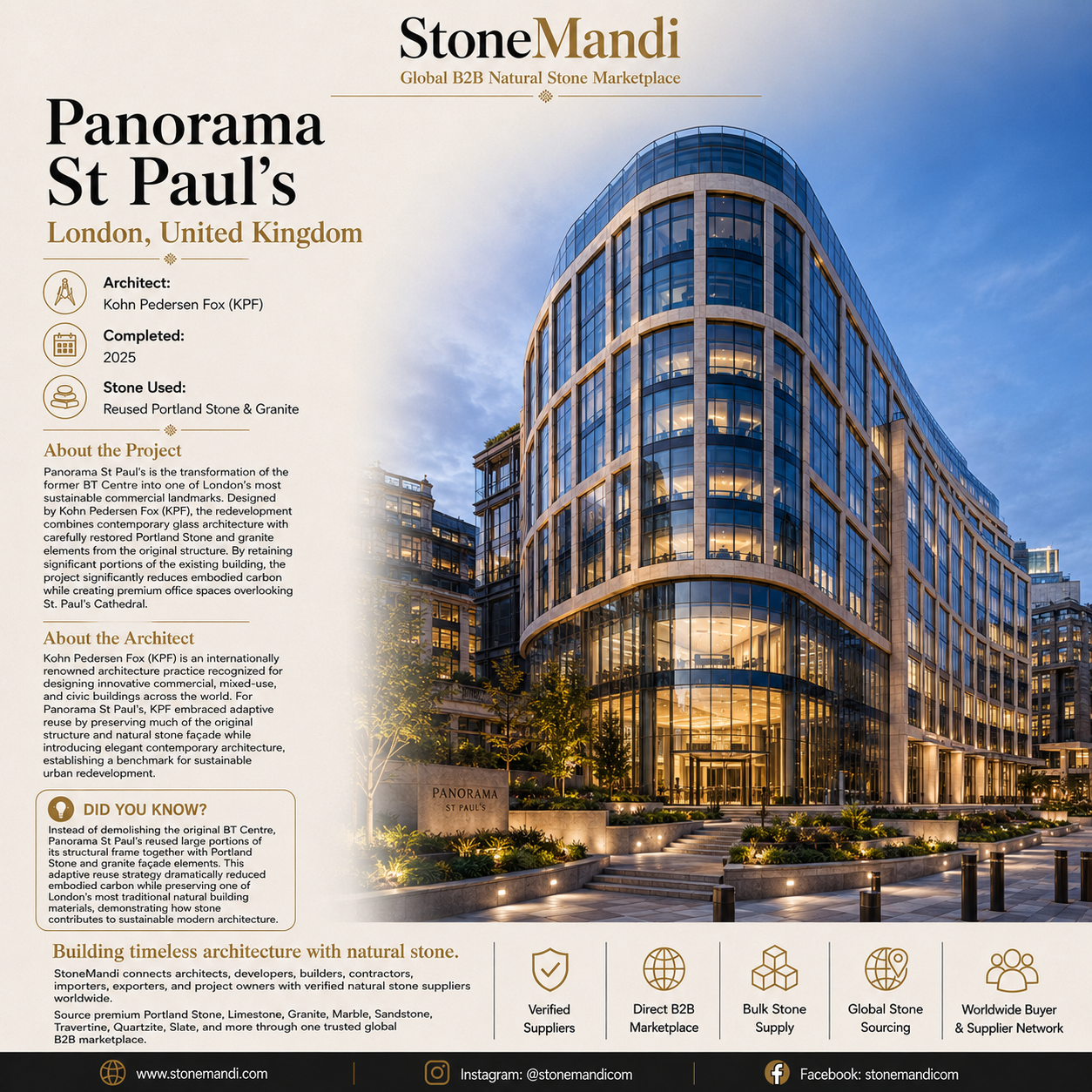
Location: London, United Kingdom | Architect: Kohn Pedersen Fox (KPF) | Completed: 2025 | Stone Used: Reused Portland Stone & Granite
About the Project
Panorama St Paul’s is the transformation of the former BT Centre at 81 Newgate Street into one of London’s most sustainable commercial landmarks. Rather than demolishing the outdated 1980s office building, architecture firm Kohn Pedersen Fox (KPF) treated the existing structure as an “urban quarry” — carefully dismantling its Portland stone and granite façade panels and reassembling them into a completely new architectural composition.
The redevelopment retains roughly 70% of the original building structure and reuses approximately 1,500 tonnes of Portland stone and granite in the new high-performance façades. This adaptive reuse strategy, carried out in collaboration with specialist stone contractor Grants of Shoreditch, dramatically reduces embodied carbon compared to demolition and new construction, while saving significant construction time and waste.
The finished building combines sweeping curved glass façades with the restored natural stone elements of the original structure, creating premium contemporary office space, landscaped terraces, and a publicly accessible rooftop with sweeping views of St. Paul’s Cathedral. At street level, a new pedestrian arcade activates the public realm and links into London’s Culture Mile. Panorama St Paul’s is targeting BREEAM “Outstanding” and NABERS 5-star sustainability ratings.
About the Architect: Kohn Pedersen Fox (KPF)
Kohn Pedersen Fox (KPF) is an internationally renowned architecture practice recognized for designing innovative commercial, mixed-use, and civic buildings across the world. For Panorama St Paul’s, KPF embraced adaptive reuse by preserving much of the original structure and natural stone façade while introducing elegant contemporary architecture — establishing a genuine benchmark for sustainable urban redevelopment.
As KPF Design Principal John Bushell put it, the recovery and reuse of stone from the old BT building is a testament to the skilled craftsmen and committed contractors who made the vision possible, and to why creative material reuse must be part of the future of redevelopment. This philosophy, sometimes described within the practice as “urban quarrying,” positions Panorama St Paul’s alongside KPF’s broader portfolio of London transformation projects, including South Bank Tower and the Unilever London Headquarters.
The Stone: Why Portland Stone Remains a Premier Construction Material
Portland Stone — a fine-grained limestone quarried on the Isle of Portland in Dorset, England — has been prized by architects and builders for centuries, most famously as the stone Sir Christopher Wren chose for St. Paul’s Cathedral itself. Its continued relevance in a landmark 2025 project situated directly opposite that same cathedral is a fitting full-circle moment for the material.
Portland Stone remains a favored choice for major construction projects for several reasons:
- Durability: As a dense limestone, Portland Stone withstands weathering, pollution, and structural stress over long periods, which is why so much of it survives intact from buildings dating back decades or centuries.
- Workability: The stone can be cut and finished with precision, allowing it to be dismantled, reshaped, and reused — exactly the process employed at Panorama St Paul’s, where existing slabs were remounted into new precast panels.
- Aesthetic Versatility: Its warm, creamy-white tone gives buildings a timeless, elegant character that pairs well with both traditional and contemporary glass-and-steel architecture.
- Sustainability: Reusing natural stone drastically cuts embodied carbon versus quarrying new material or using energy-intensive synthetic cladding. At Panorama St Paul’s, this reuse strategy was central to the project’s low-carbon credentials.
- Structural Reliability: Portland Stone’s compressive strength and stability make it dependable for façade cladding on high-rise and commercial buildings alike.
These qualities are exactly why natural stone — Portland Stone included — continues to be specified on premium developments worldwide, and why sourcing it from verified, reliable suppliers matters as much as the material itself.
Sourcing Natural Stone for Projects Like This
Projects such as Panorama St Paul’s demonstrate how natural stone, when properly sourced and thoughtfully specified, can deliver both architectural distinction and genuine sustainability outcomes. For architects, developers, and contractors looking to source Portland Stone, granite, limestone, or other premium natural stone for their own projects, working with a trusted global supplier network is essential to ensuring quality, consistency, and reliable bulk supply.
StoneMandi.com is a global B2B natural stone marketplace that connects architects, developers, builders, contractors, importers, exporters, and project owners with verified natural stone suppliers worldwide. Whether the requirement is Portland Stone, limestone, granite, marble, sandstone, travertine, quartzite, or slate, StoneMandi.com offers direct B2B sourcing, bulk stone supply, and a worldwide buyer and supplier network built for projects of any scale.
For architecture and construction professionals inspired by adaptive reuse projects like Panorama St Paul’s, StoneMandi.com makes it possible to source the same caliber of premium natural stone through one trusted, verified global marketplace — building timeless architecture with natural stone.
Sources: KPF, Grants of Shoreditch, Architects’ Journal, New London Architecture